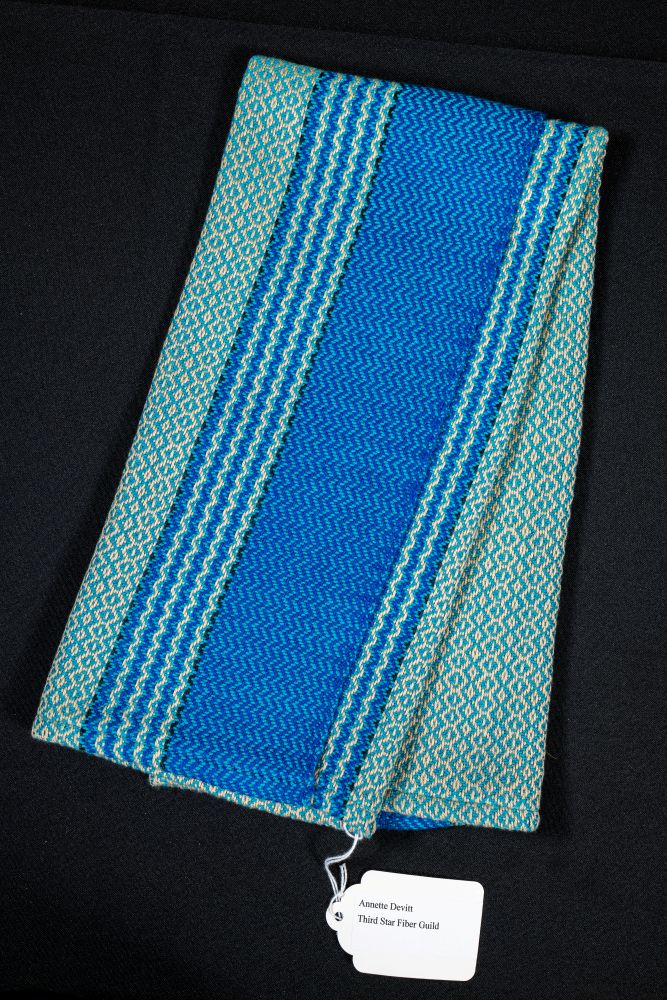
Birds Eye Twill

MAFA2025-3962

RIC RAC STRIPE TOWEL

Number of warp ends per color
Royal – 160 ends (includes a floating selvage thread not shown on draft)
Flax – 229 ends
Black – 8 ends

MEASUREMENTS
Warp in reed = 20”
On-loom = 18.5” x 33”
Off-loom = 18” x 31.5”
Hemmed and washed = 17.25” x 28.5”

Machine hemmed.

The ric rac effect in the stripes is prominent on one side than the other. I used that as the right side of the towel.

MAFA2025-3871

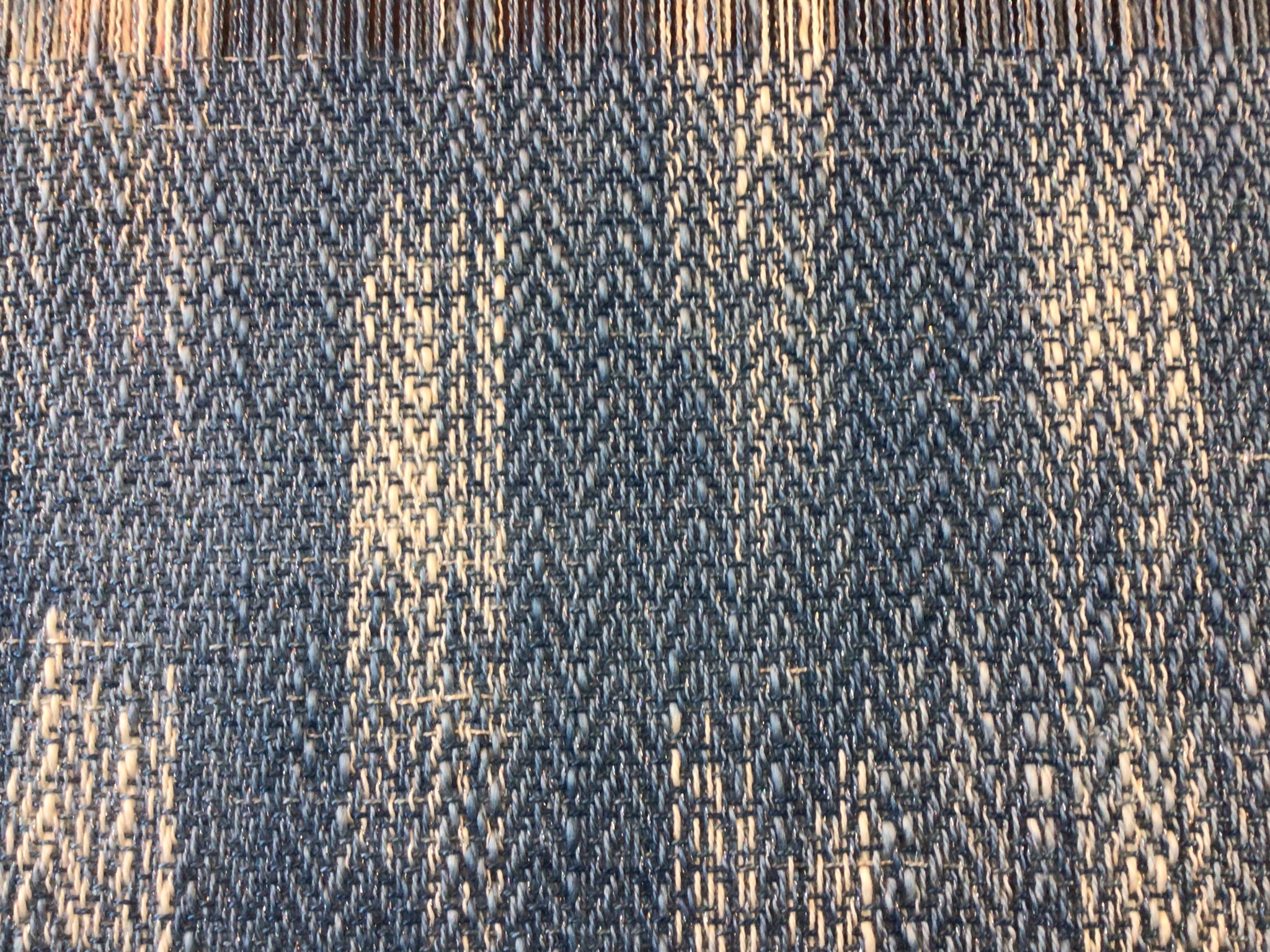
At MAFA 2023, I created a shirt pattern in my class with Cal Patch. I wanted to use that pattern again, but for a different style of shirt. I plan to make this new shirt more like a tunic and possibly with a square neck. The front and back will be three pieces with two bird’s eye pieces on the front with one plain piece. The back will be the opposite.

In October 2024, our guild did some indigo dyeing. I decided to dye a warp at this event for my shirt. I found a commercial shirt pattern that helped me figure out what I wanted to do with my own shirt. This pattern involved two different fabrics – which I could create on one warp.

I made a six yard warp that has 1056 ends set at 24 epi. Half the warp was woven in a Bird’s Eye pattern beat at about 16 ppi. I used some 10/2 cotton that I had dyed at a different workshop for my weft. It was also dyed with indigo. The second half of the warp is plain weave woven with a mill end light blue cotton.

I did attempt some space dyeing on my warp, but I did not allow enough dye to get into the plain weave half of the warp. So the whole warp looks somewhat space dyed. I also should have been more patient and let my warp sit in the dye bath longer. I would have liked for the blue to be deeper.

The beat for this fabric was challenging for me. I like a firm beat. I usually match my epi and ppi. This was a good exercise for me. The fabric is loose and should be a good summer weight.

MAFA2025-3751

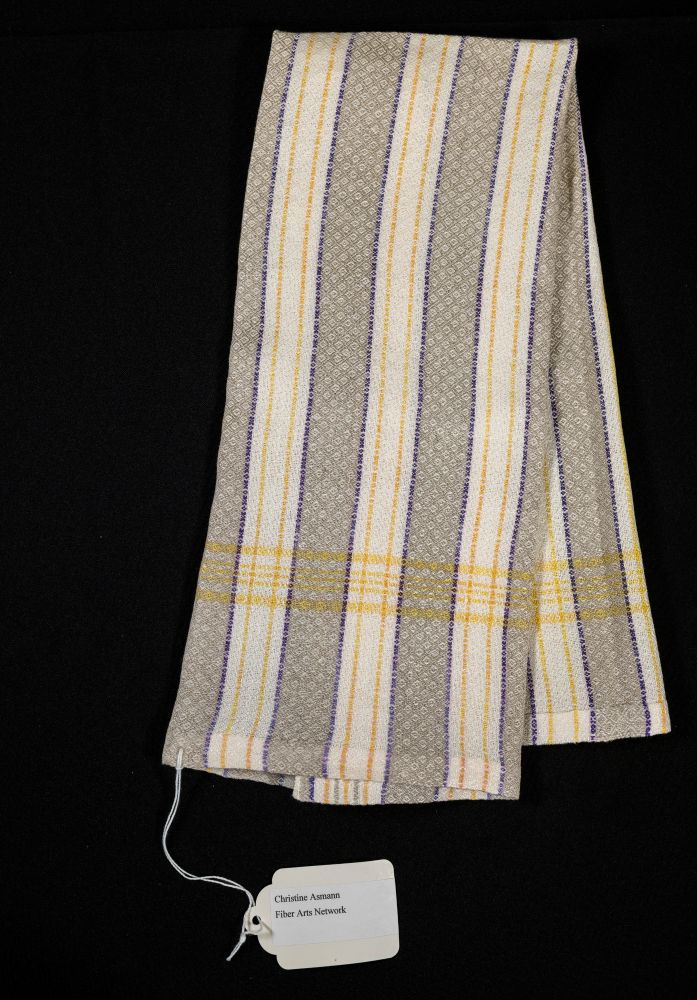
This is an adaptation of an antique towel in my collection, from Germany and dating between 1890 and 1918. It has purple and yellow stripes that are evenly spaced, but out of sync with the twill pattern.

I reverse engineered the pattern and adjusted it to make the colored stripes wider and align them evenly in the twill pattern repeats. I also made some changes to the edges, again for symmetry.
A very similar goose-eye draft is here:
https://www.handweaving.net/collection-drafts/keyword?keyword=26694&page=0

Page 122, Figure 19, Donat, Franz Large Book of Textile Patterns, Germany, 1895, #26694 on Handweaving.net. I did not use this draft, but it is very similar and this type of twill is common among my towels from this period.

The original towel is monogrammed MT, and it has a measured EPI of 42 with 37 average PPI. It appears to be lea 70 or 80 linen singles. It has plain weave selvedges and a tiny turned hem sewn by machine. My sett is less dense to account for 40/2 linen, which was the finest I had for this project.

My towel has hand sewn hems using linen thread. The colors are half-bleached and natural linen as purchased, and half-bleached linen hand dyed to approximate the colors of the original towel, in bright yellow and clear, bright purple.

The towel was woven on a Glimåkra standard coutermarche using regular shuttles and rotary temple.

MAFA2019-081

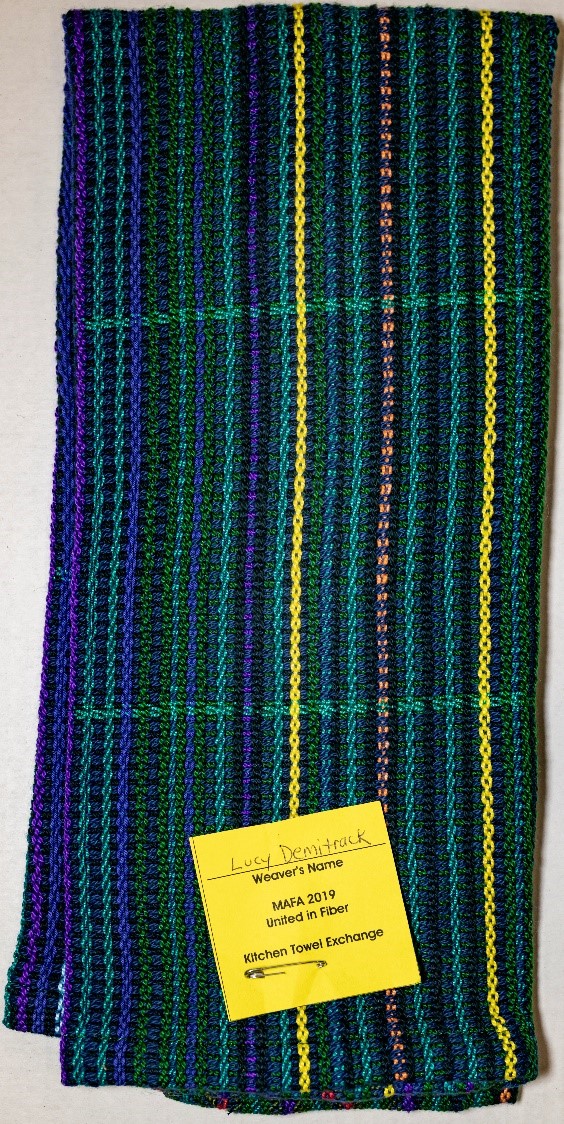
The yarn was predominantly unmercerized cotton. The goal was to use yarns from dark to light so that the light warps would stand out. The colors were chosen as I wound the warp. Occasionally perle cotton was used if the color sequence required it and I ran out of other options.

MAFA2019-013

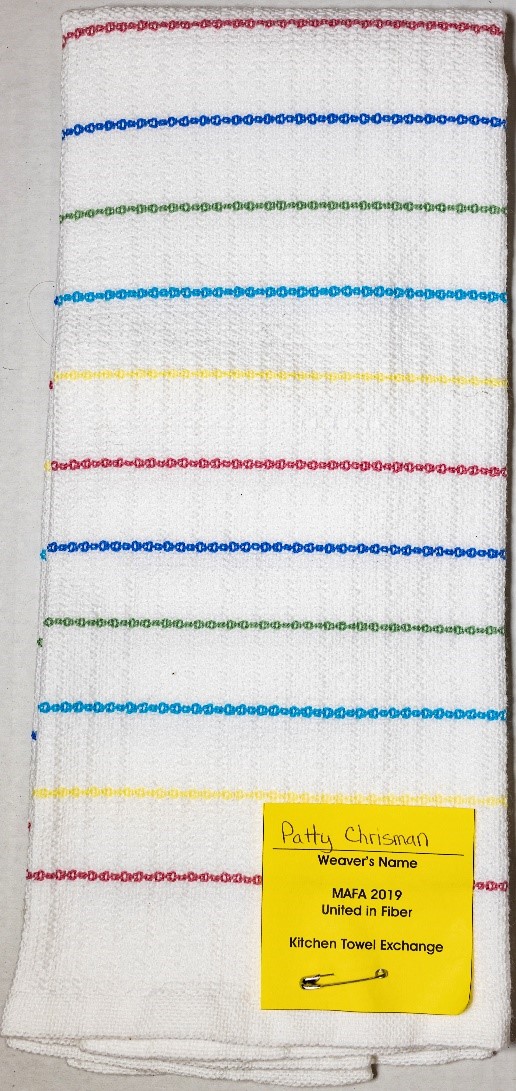
This twill is threaded and treadled based on draft on Heinrich Woolhever’s 1821 Pattern Books Draft. It represents further use of a pattern I chose to explore for the Early Weaving Books and Manuscripts Group of Complex Weavers. The cheerful stripes are my addition.