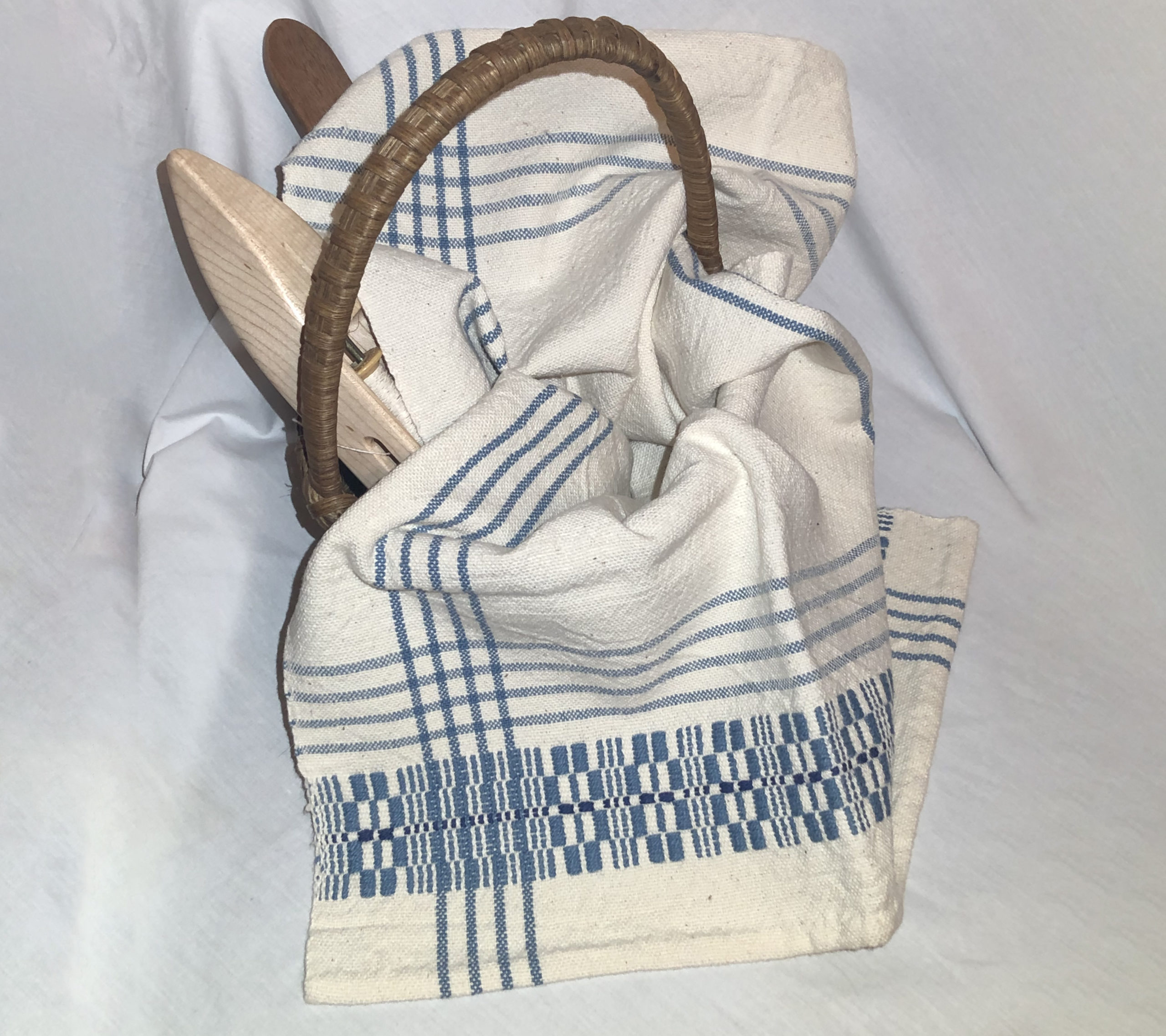
I used the napkin patterns in the Handwoven article and adapted them. I used the treadling for towel 1.
I began and ended the towel with 1 ½ inches of 10/2 weft to make the hems a little less chunky.
20″ in reed; 30″ long. Warp ends: 488 + selvages.

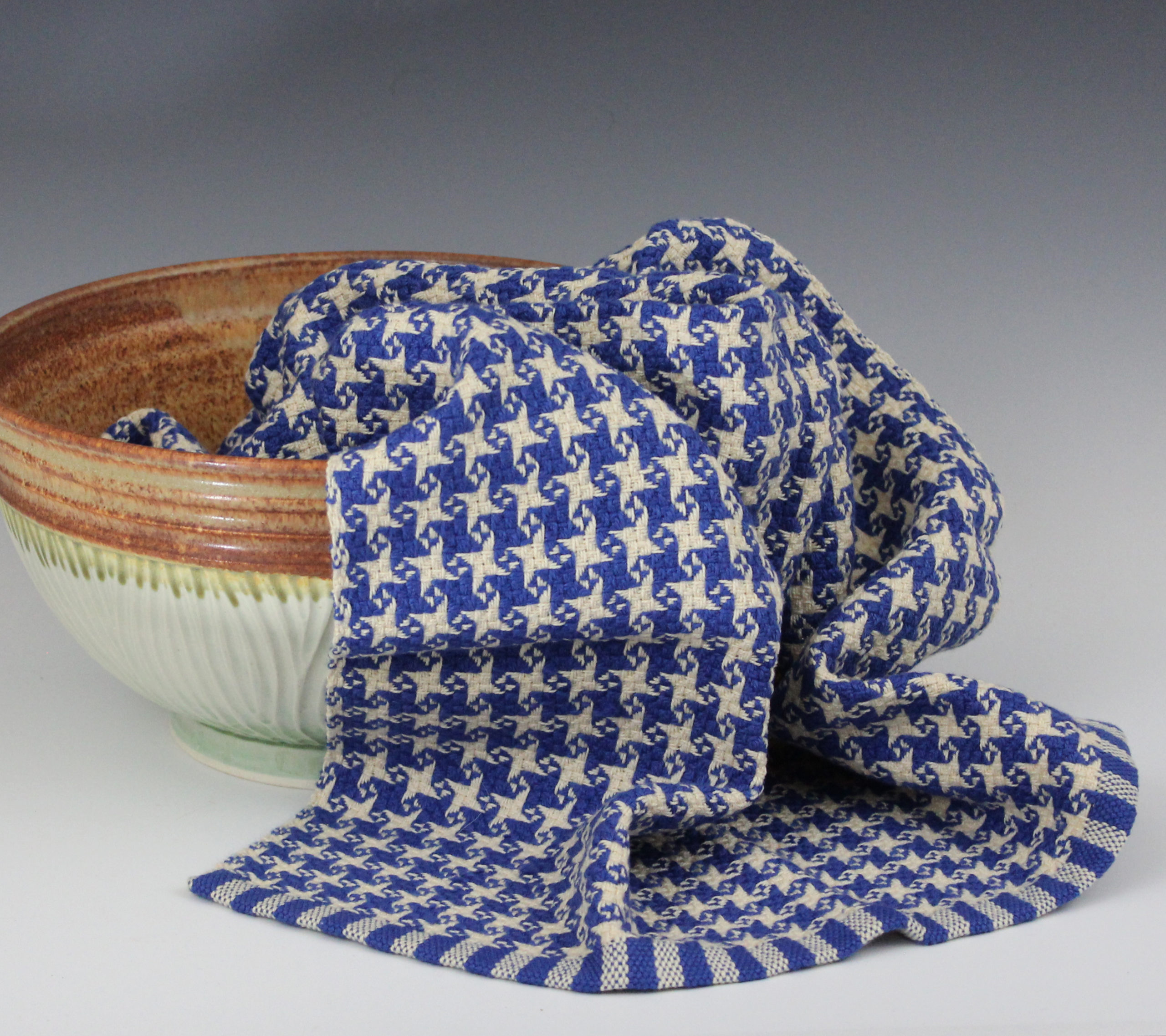
I used the napkin patterns in the Handwoven article and adapted them. I used the treadling for towel 1.
I began and ended the towel with 1 ½ inches of 10/2 weft to make the hems a little less chunky.
20″ in reed; 30″ long. Warp ends: 488 + selvages.
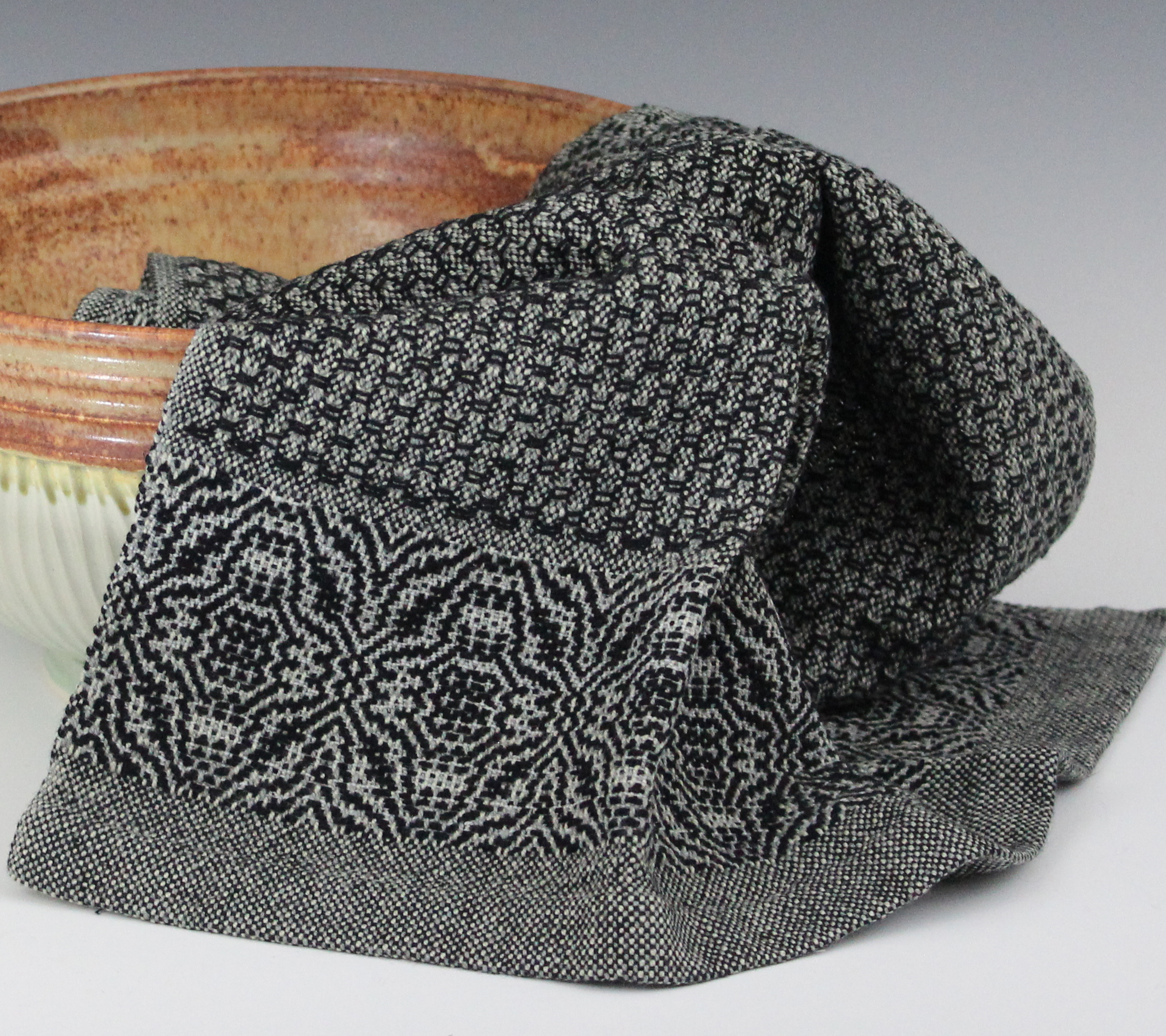
This is a draft that blends overshot and huck with plainweave in between. It was very hard to beat the overshot to square, so I ended up using sewing thread for tabby.
418 ends; 2.5 yards long. 8-shaft loom, 21″ weaving width; 10 dent reed.
The towel was washed in warm water and dried. Pressed hard to set the pattern. The hem is handsewn.
Warp is a mix of 8/2 natural Bockens cotton and 8/2 Bockens Nialin (2003 gray).
Weft is 8/2 black cottolin.
The overshot border is 5/2 Valley Yarns perle cotton for the pattern (8990 black). The tabby is black linen sewing thread.
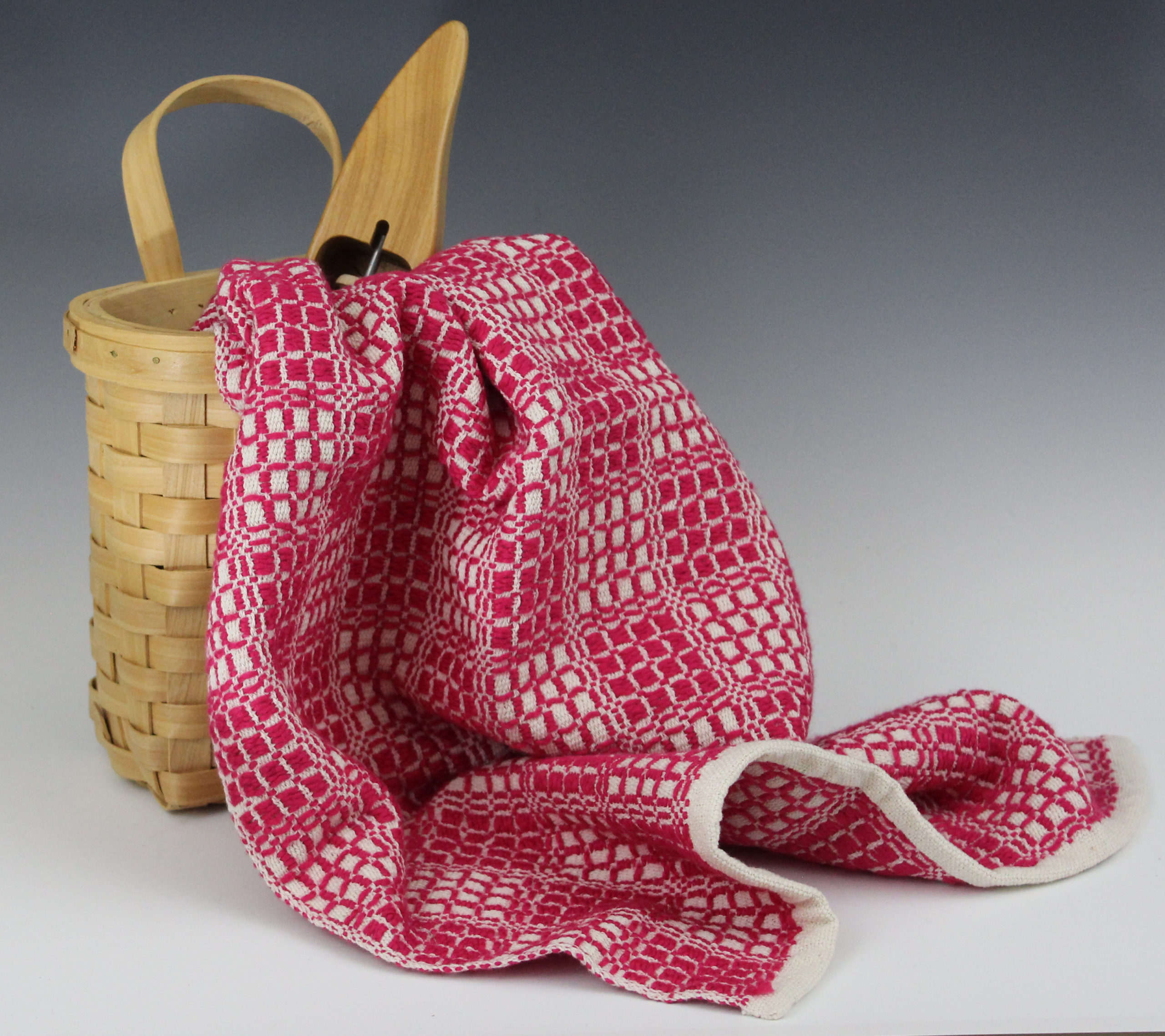
I made 6 towels on this warp. For all the towels except this one, I used 8/2 cotton. On this towel, I used a thicker cotton (Conshohocken ‘Softball’ cotton, color 088 – cherry). It made the whole towel very fluffy and I loved it.
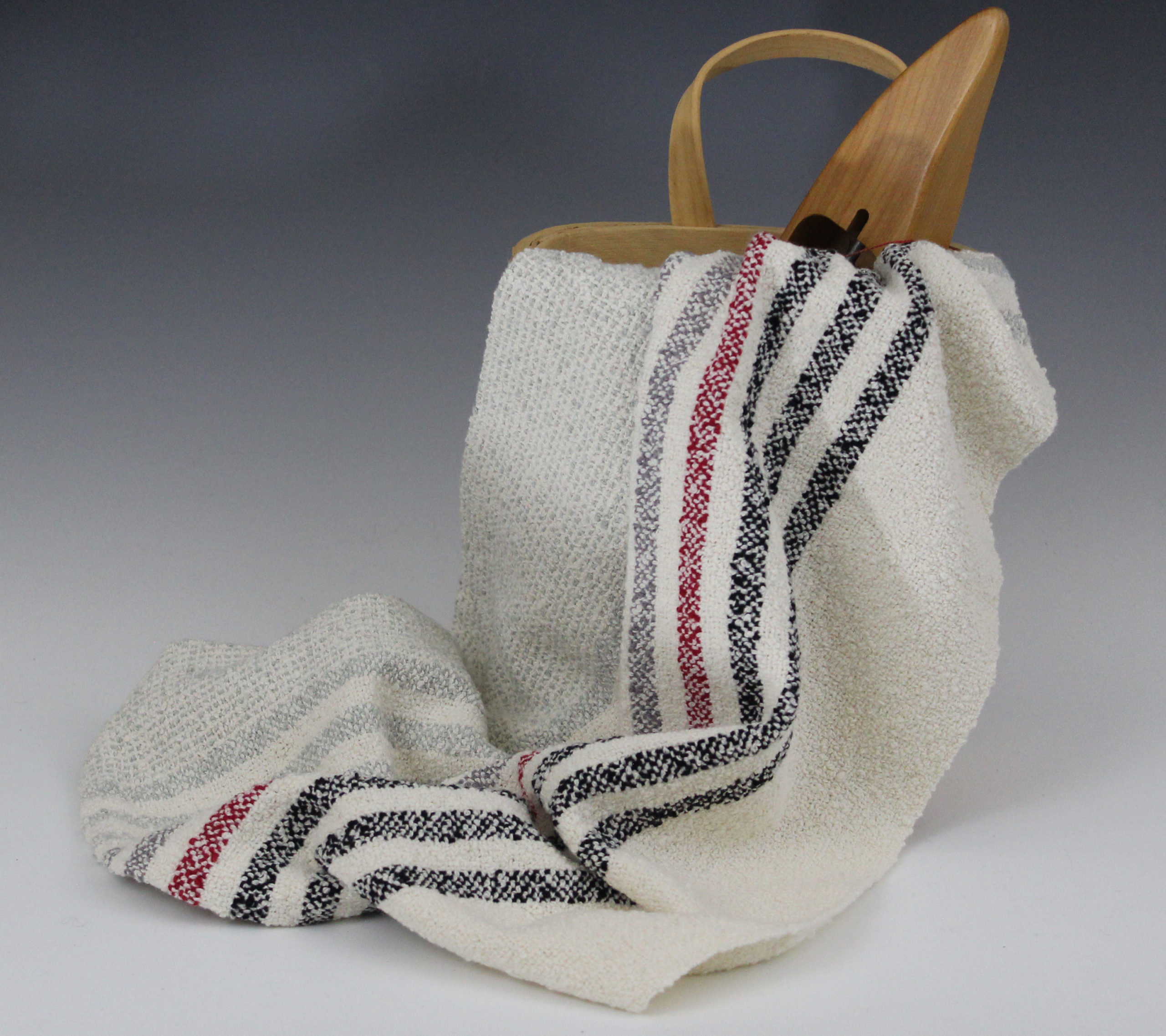
I varied Jane’s original design, but started with her ideas. My fiber is actually cotton boucle and cottolin.
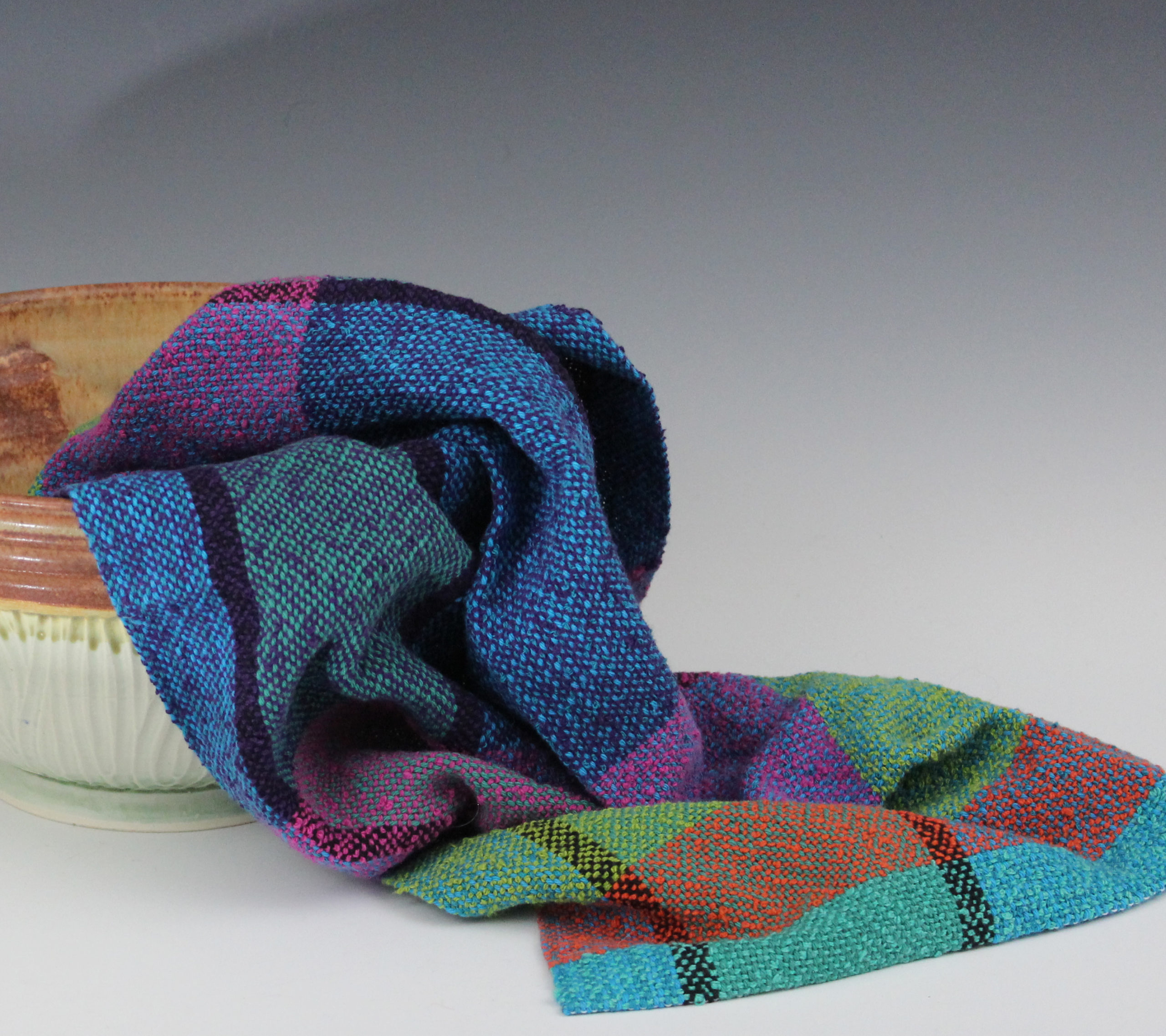
I just started weaving in August 2020. My fiber friends, who are also weavers, encouraged me to join Jane Stafford’s Online Guild. I fell in love with Jane’s boucle towel kits and bought two for the colors. However, I wanted to try something I had not seen, towels woven with 8/4 cotton as warp, with the goal being a thick absorbent towel with texture. For added texture, the warp in the center was created by alternating 8/4 cotton warp with a matching boucle yarn. I wanted to see if there would be much difference between the combo 8/4 cotton + cotton boucle versus 8/4 cotton alone.
The towel weft was woven with boucle alone, alternating colors and weaving inches to follow Fibonacci sequences (1, 2 ,3, 5, 8, 5, 3, 2, 1). Color progression: aqua, orange, light green, fuchsia, and purple. I wanted the colors to play together in the towel to create visual interest. While I was very reluctant to weave with purple boucle as part of my design, I found this color series one of my favorites. Interestingly, after finishing, there did not seem to be a great textural difference between the areas woven with the 8/4 cotton + boucle combo or in the 8/4 cotton warp alone.
The hems were woven with 16/2 cotton and hand stitched. I hope you will enjoy this towel as much as I enjoyed weaving it!
Warp: 12epi 8/4 carpet warp, 266 warp ends total.
Sley: 20 ends peacock, 6 black, 45 jade, 6 black, 56 each peacock and peacock boucle, 6 black, 45 jade, 6 black, 20 peacock
Weft: cotton boucle in aqua, orange, light green, fuchsia, and purple
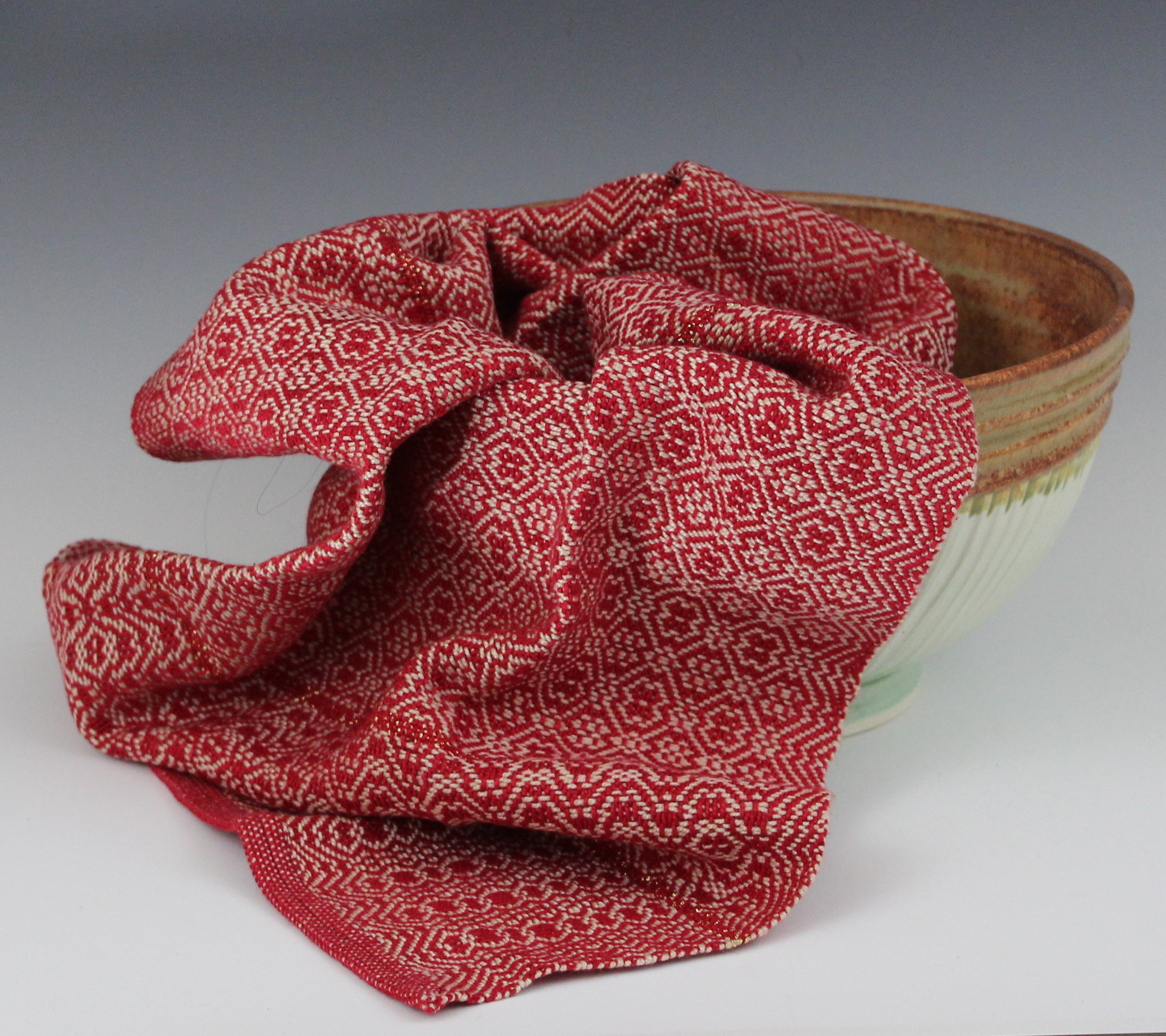
Traditional twill threadings like the Ms & Ws I used lend themselves to treadling variations. This towel includes straight, point, as-drawn-in, and several variations I “unvented” while playing around with Fiberworks. In the MAFA Samples Database, there is a second .wif file showing all the treadlings I considered when designing this towel. (Remember to add tabby if you used the overshot treadling at the end.) Of course, you can also create treadling variations at the loom by alternating odd and even treadles as the spirit moves you, or by applying concepts from structures such as overshot. I hope that this towel inspires you to create something that is uniquely yours.
I’m also using this warp to weave my swatches for Jockey Hollow Weavers’ annual exchange; this year’s theme is “Red,” for the guild’s 40th (ruby) anniversary. (2021 is also the ruby anniversary of the first MAFA conference; JHW’s founders were inspired to create a guild in their area after attending the conference.) And, being a lazy weaver, I’m also using this warp to weave additional squares for Violet Protest, a public art project created by Ann Morton. (www.violetprotest.com/about)
Sett: 20 epi (2/dent in 10-dent reed)
Ends: (22 ends/repeat * 16 repeats) + 11 (M to balance) + 24 (border) = 387
WIR: 19.65″
Hem: 1/2″ turned hem -> 1.5″. Wove in a scrap piece of 5/2 to mark the folds; pulled this yarn right before pressing the hem just prior to machine-sewing.
Border: 12 picks, about 1/2″
Edge pattern : 3.5″
Band pattern: ~ 2″ (49 picks)
Body pattern: 12.5″
4 picks of plainweave metallic to separate patterns
Mirror second half (which I did not do as precisely as I had intended.)
Used a weighted floating selvage. Draw-in was greater than expected; used a temple. Shrinkage after machine washing and drying was 10% widthwise and negligible lengthwise (which makes me suspect I mis-measured when it was on the loom; I would have expected 10-15%).
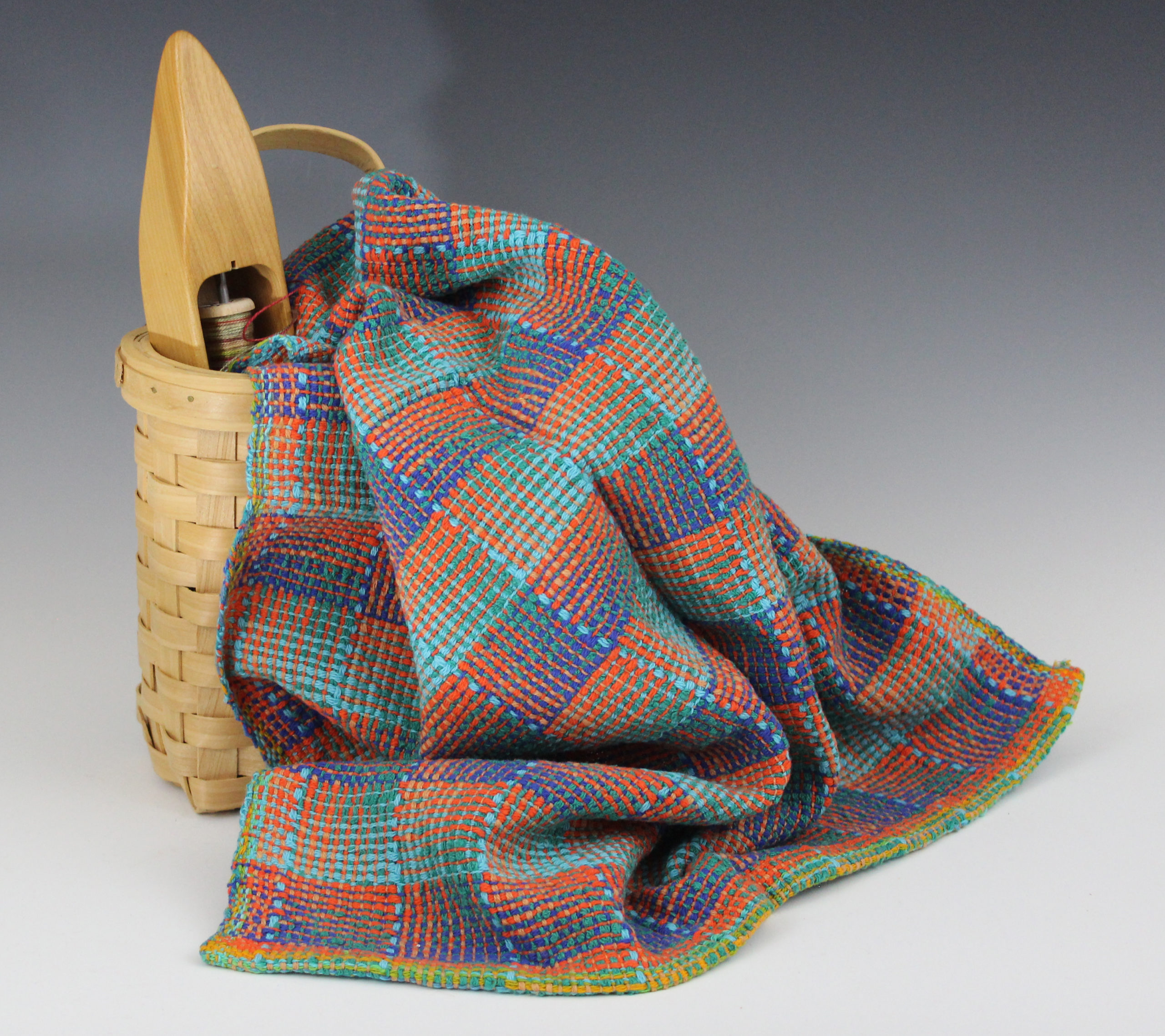
Hems are in plain weave using quilting weight sewing thread—weave 1/2″, insert thicker white yarn, another 1/2″ and another thicker yarn, and the last 1/2″. That gives a crisp fold line (after pulling out the thicker threads) for your hems.
Cotton bouclé (teal) in warp is a bear to wind on—lots of patience needed! You will need floating selvages. This can easily be converted to 2 or 4 shafts.
Colors were inspired after seeing a picture of a colorful snake: pin.it/54e2cww
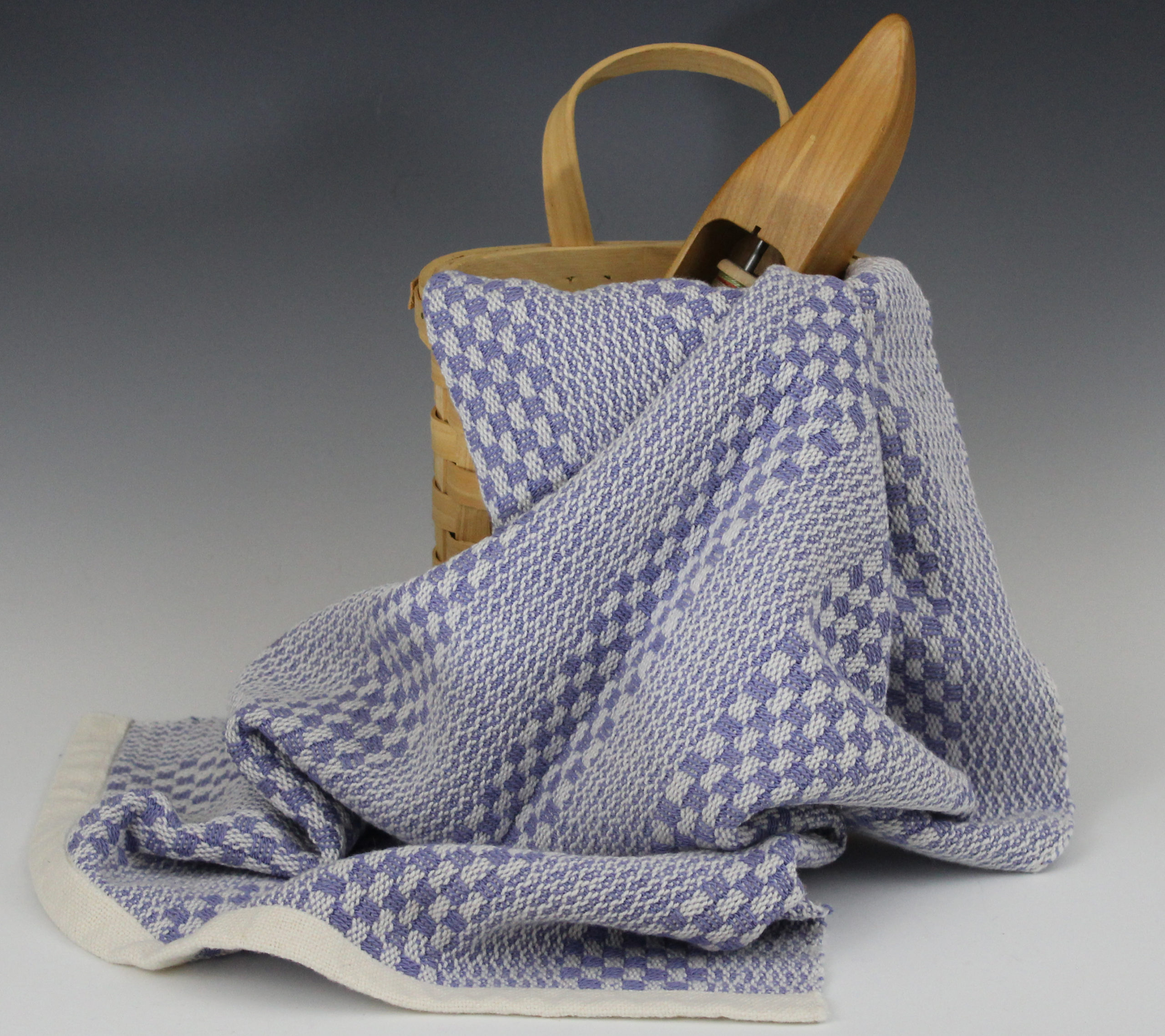
This is a popular draft for kitchen towels with good reason. It is a fun weave and produces a good looking towel. I hope you enjoy using it as much as I enjoyed weaving it.
The Schacht website describes the “Friendship Towels” pattern: “This is a project originally designed by Mary Ann Geers which we published in the May/June 1985 issue of Handwoven magazine when I was editor. I loved it so much that I included it in A Handwoven Treasury, a collection of articles and projects from the first 10 years of Handwoven magazine. The threading is huck-a-back blocks from Marguerite Davison’s A Handweaver’s Pattern Book.”

I was inspired when Judith, a member of our guild, wove this for our April 2021 newsletter sample.
This was fun. I put on five yards of warp, total of 562 ends (used floating selvages). I had a 20 inch width and wove 32 inches in length. I threaded one inch plainweave on each side and wove two inches of plainweave at the bottom. I wove the 1/2 inch hem in finer cottlin so that it would have less bulk.
The weave is a standard huck lace and is very versatile. Lots of different treadling patterns.
My stripes are based on Fibonacci numbers. I started with one repeat in cottolin, then a blue stripe of one repeat, then one beige repeat again, then a blue stripe, then two beige repeats, blue stripe and lastly three cottolin repeats and a blue stripe. The beige cottolin stripes are following the Fibonacci sequence of adding the last two numbers together – 1,1,2,3. The next number would be 5. I use this sequence often.
Judith has taught me a lot over the last few years and it seems appropriate to share her weaving pattern with others. If you want to see what Judith wove and other weaving that the Richmond Weaving Guild has shared, go here: www.flickr.com/photos/128696390@N07.