
Fiber Arts Network

MAFA2025-3751

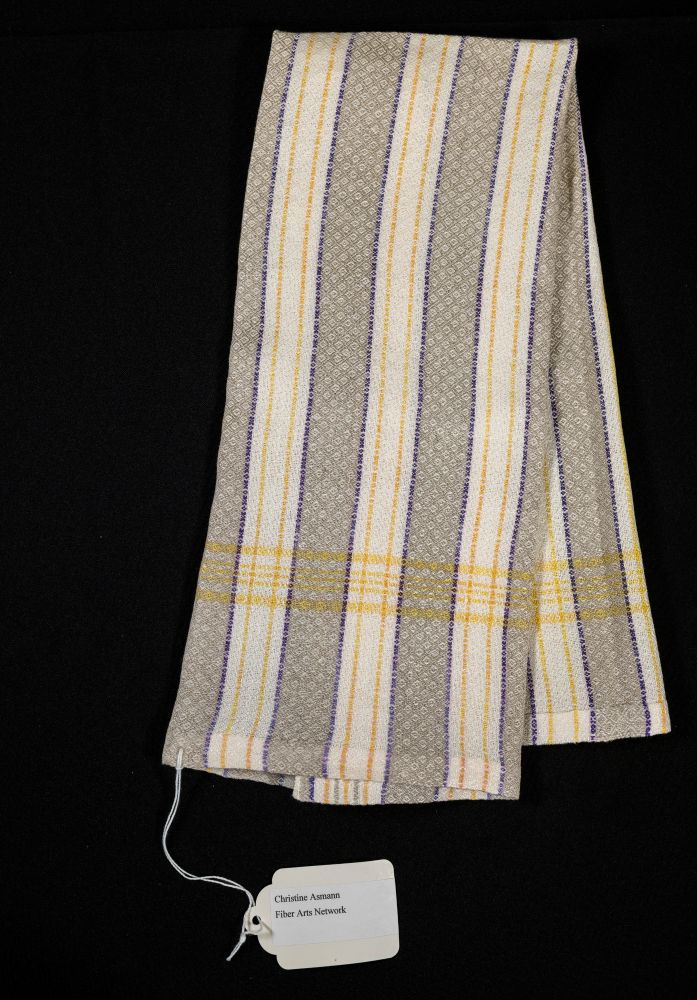
This is an adaptation of an antique towel in my collection, from Germany and dating between 1890 and 1918. It has purple and yellow stripes that are evenly spaced, but out of sync with the twill pattern.

I reverse engineered the pattern and adjusted it to make the colored stripes wider and align them evenly in the twill pattern repeats. I also made some changes to the edges, again for symmetry.
A very similar goose-eye draft is here:
https://www.handweaving.net/collection-drafts/keyword?keyword=26694&page=0

Page 122, Figure 19, Donat, Franz Large Book of Textile Patterns, Germany, 1895, #26694 on Handweaving.net. I did not use this draft, but it is very similar and this type of twill is common among my towels from this period.

The original towel is monogrammed MT, and it has a measured EPI of 42 with 37 average PPI. It appears to be lea 70 or 80 linen singles. It has plain weave selvedges and a tiny turned hem sewn by machine. My sett is less dense to account for 40/2 linen, which was the finest I had for this project.

My towel has hand sewn hems using linen thread. The colors are half-bleached and natural linen as purchased, and half-bleached linen hand dyed to approximate the colors of the original towel, in bright yellow and clear, bright purple.

The towel was woven on a Glimåkra standard coutermarche using regular shuttles and rotary temple.
MAFA2023-002

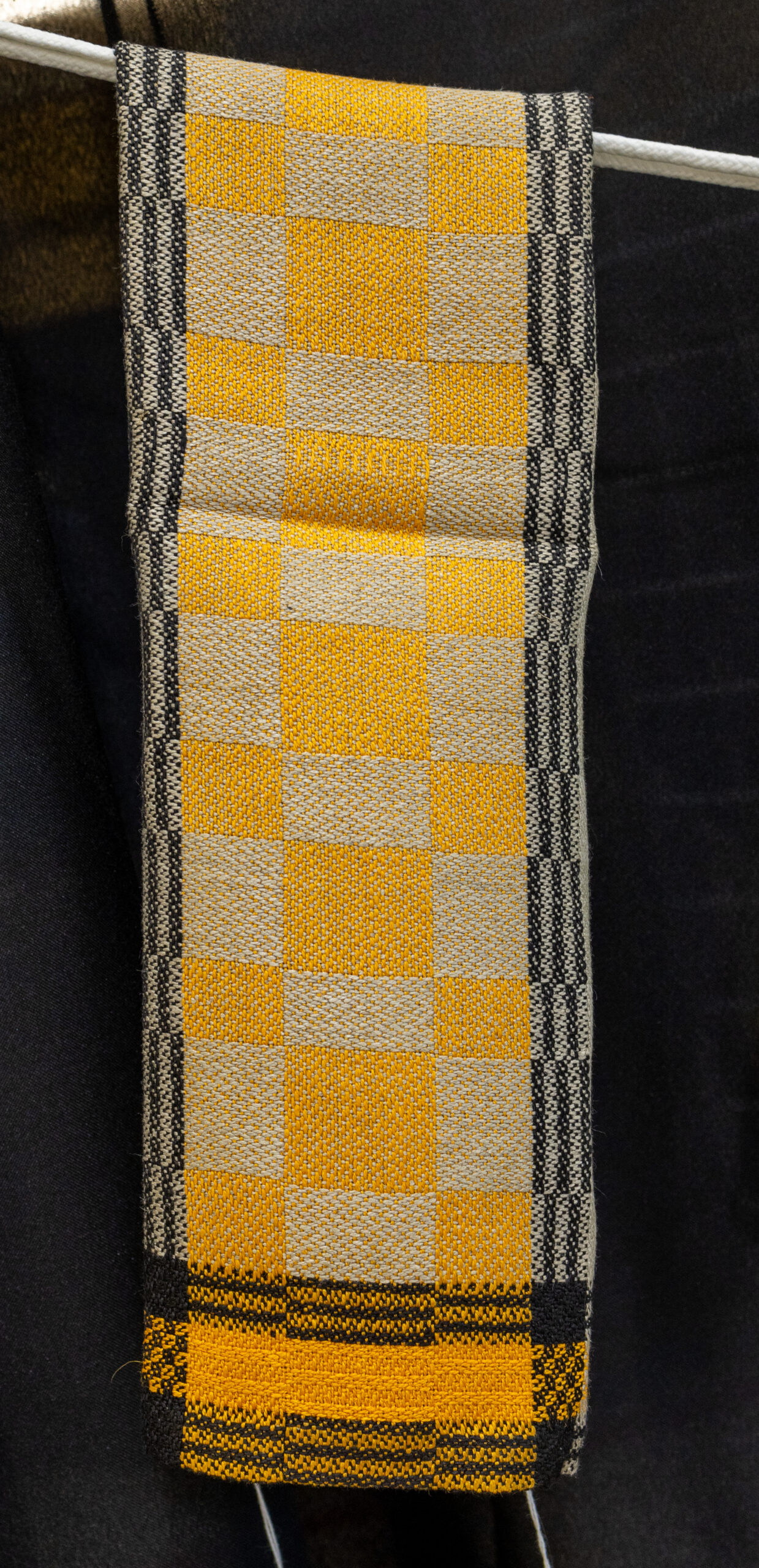
I made a few small changes to the draft (especially the tie-up, so I could walk the treadling) but none of my changes alter the result in any significant way and credit for this design belongs fully with Ms. Hall.

This towel used 368 ends and was woven on a Glimåkra Standard. It was 143 grammes after hemming but before wet finishing. I wove with the weft threads wetted.

In the reed it was 15 .25″.
Off the loom it was 15″ and trimmed to 33″ in length. After hemming it was 15″ x 31.5″
After wet finishing it is 14.5″ x 30.75″

MAFA2019-046

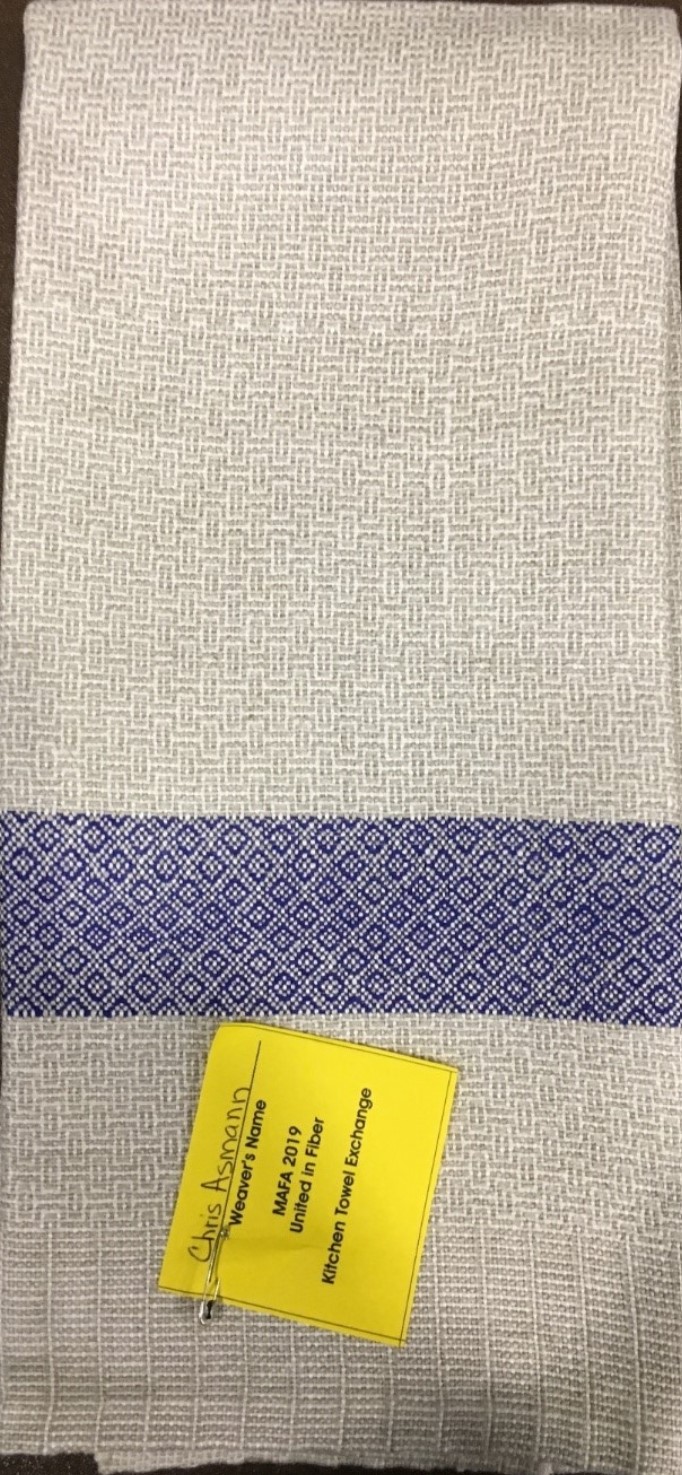
Linen warp bobbins had to be very wet to prevent loops in the selvedge. Tension was a problem throughout and I helped that by spraying the threads. The yarn seems too coarse to make a really nice towel.

MAFA2021-001

I am a novice weaver, and this is my 10th project. I had initially planned this project for 40/2 linen, but I was unable to find colored linen in that grist. Scaled up for 16/2 linen the pattern is more dramatic and the cloth is robust. This wasn’t what I envisioned when I planned the project, but I am satisfied with the outcome. It’s not perfect, but it is perfectly functional. I hope it will provide many years of service.

I wove on a Glimåkra Standard using 8 shafts. A ladder hemstitched section was added after a partial pattern repeat and it was reversed to duplicate the design on the second hem. Both hems are hand sewn with linen thread.

Initial size was 33.5″ x 19.5″; hemmed it was 31″ x 19.5″ and final size after washing and pressing is 29.75″ x 18.5″. I hard pressed with a heavy iron to give the linen a polished appearance.
There are 392 ends in the warp with a partial repeat at one end to have similar left and right sides in the finished towel. This is in the attached WIF. Likewise there is a partial repeat and a reverse in the hems, for the same reason. It’s shown on the beginning of the file only. I sleyed 1 end per dent in a 20 dent reed. I wove with a temple and the weft was wetted on the bobbins to help it beat in well and make a more dense cloth.

I wove this without floating selvages but the pattern would benefit from them. The colors do not alternate 1:1. Because of this, to make sure all the warp ends were caught in each pick, the shuttles had to cross sometimes in one direction, other times the reverse. It made for slower weaving and uneven selvages.

The original source of this color-and-weave design is: Die Färbige Gewebermusturung by Franz Donat, published in 1907. This particular draft is a figure from Master Plate XLVIII No. 6A, Motif 4.