Huck|Huckaback

MAFA2025-3797

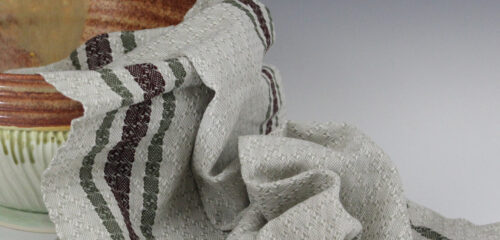
Adding a quarter inch of plain weave at each selvage makes weaving this a lot easier. you don’t have to worry about floating selvages and oddness at the edge because of floats. Same goes for the plain weave at the ends. It’s much easier to hem a plain weave towel on the sewing machine. I have also found that adding some fray check in addition to zig-zagging the raw edge of the finished towel, makes it easier to hem the corners. Also, do not attempt to machine hem this towel unless your sewing machine has a heavy duty motor.

MAFA2023-044

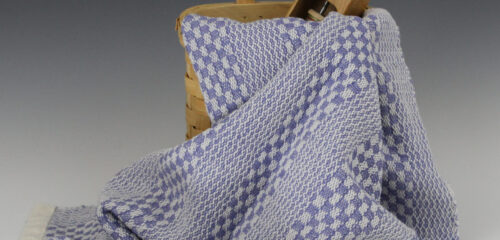
The threading is called huck variation by Russell E. Groff. I experimented with twill tie ups, but treadled as drawn, 121, 343, 121, 565, 787, 565.

Weaving in the reed was 20.5, “ and the shrinkage was 15%.

Total warp ends: 414 plus 1 floating selvage on each side.

Towel was hand hemmed.

MAFA2023-031

I wet finished the towel by boiling it in water with dawn detergent for one hour and laid it flat to dry.
I used a 19th century draft for a southern counterpane from Martin Marshall an Alabama weaver. I have not been able to find the original owner of the draft attributed to a private owner in the Made in Alabama book.

MAFA2023-034

I used 2 patterns – one was Rosalie Neilson’s from her class and one of my own created in the class. There are 4 colors in both the warp and weft. I experimented with different colors in the weft. Floating selvedges were used. There was about 15% shrinkage.

MAFA2021-045

20″ wide, 600 ends plus floating selvages.
Straight draw on 24 shafts so each towel could be different.
I put on a 10 yard warp.
I wove each towel about 37″ on the loom and hand hemmed.
The towels are generously sized; the one for the towel exchange has finished dimensions of 17.75″ by 30.75″.
Relatively lightweight, easy to use towels.

This was inspired by “Santa Cloth” by Becky Hamblin in The Best of Weaver’s: Huck Lace, and she cites Thomas Jackson, Weaver, Shuttle Craft Monograph 13. Originally a 12 shaft pattern, I used 24 shafts and so was able to come up with several variations on the pattern. This one has a huck border around plain weave diamonds.

MAFA2021-048

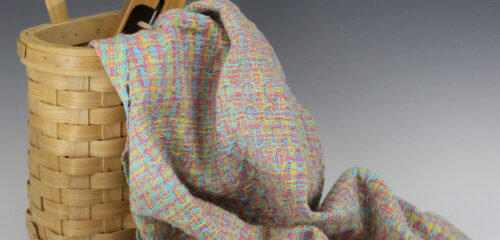
Woven in Valley Yarns 8/2 variegated unmercerized cotton in the ‘Cotton Candy’ colorway. It was interesting to weave because of the variegated yarn. Six towels were woven then zigzagged on the sewing machine. They were washed and dried in the dryer then cut apart and hemmed. The hemming area was plainweave.

MAFA2021-038

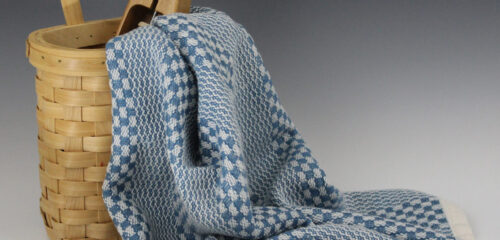
The original draft I found on the Schacht website had 414 ends, so I adjusted to 430 ends to meet the necessary width requirement. I also used a simplified threading, a draft of which was supplied to me by Judie Eatough.

I machine washed the towel in cold water and dried in the dryer on high heat to wet set. The towel was then pressed using a cotton and steam setting on my iron.

I used a 12 yard warp of 8/2 ring spun cotton and used Brassard’s 8/2 cotton for weft in the color Vieu Blue.

The towel was machine hemmed.

I love weaving these towels as the pattern is so easy to memorize and you can just weave almost without thought. The easy simplified threading I used makes threading the heddles an easy task.

MAFA2021-027

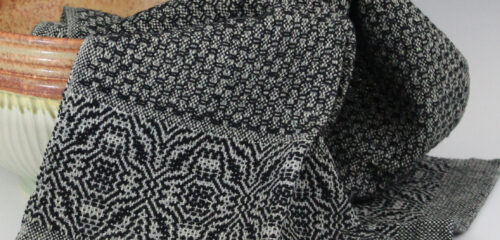
This is a draft that blends overshot and huck with plainweave in between. It was very hard to beat the overshot to square, so I ended up using sewing thread for tabby.

418 ends; 2.5 yards long. 8-shaft loom, 21″ weaving width; 10 dent reed.

The towel was washed in warm water and dried. Pressed hard to set the pattern. The hem is handsewn.

Warp is a mix of 8/2 natural Bockens cotton and 8/2 Bockens Nialin (2003 gray).
Weft is 8/2 black cottolin.
The overshot border is 5/2 Valley Yarns perle cotton for the pattern (8990 black). The tabby is black linen sewing thread.

MAFA2021-014

This is a popular draft for kitchen towels with good reason. It is a fun weave and produces a good looking towel. I hope you enjoy using it as much as I enjoyed weaving it.

The Schacht website describes the “Friendship Towels” pattern: “This is a project originally designed by Mary Ann Geers which we published in the May/June 1985 issue of Handwoven magazine when I was editor. I loved it so much that I included it in A Handwoven Treasury, a collection of articles and projects from the first 10 years of Handwoven magazine. The threading is huck-a-back blocks from Marguerite Davison’s A Handweaver’s Pattern Book.”

MAFA2021-015

I was inspired when Judith, a member of our guild, wove this for our April 2021 newsletter sample.

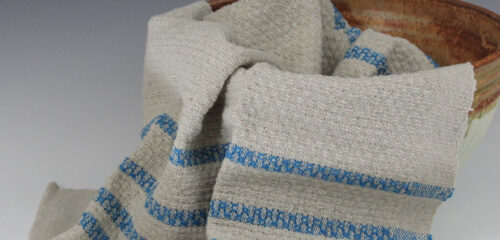
This was fun. I put on five yards of warp, total of 562 ends (used floating selvages). I had a 20 inch width and wove 32 inches in length. I threaded one inch plainweave on each side and wove two inches of plainweave at the bottom. I wove the 1/2 inch hem in finer cottlin so that it would have less bulk.

The weave is a standard huck lace and is very versatile. Lots of different treadling patterns.

My stripes are based on Fibonacci numbers. I started with one repeat in cottolin, then a blue stripe of one repeat, then one beige repeat again, then a blue stripe, then two beige repeats, blue stripe and lastly three cottolin repeats and a blue stripe. The beige cottolin stripes are following the Fibonacci sequence of adding the last two numbers together – 1,1,2,3. The next number would be 5. I use this sequence often.

Judith has taught me a lot over the last few years and it seems appropriate to share her weaving pattern with others. If you want to see what Judith wove and other weaving that the Richmond Weaving Guild has shared, go here: www.flickr.com/photos/128696390@N07.