Central PA Guild of Handweavers

MAFA2025-3933

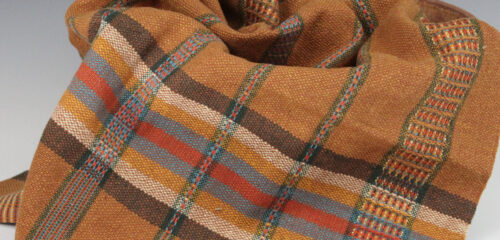
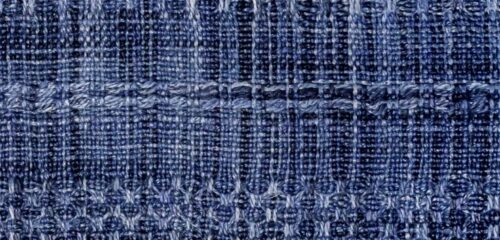
The piece is woven using Deborah Silver’s split-shed technique. I hand-drew the cartoon for the pickup oatterning.

I warped my table loom with enough for two runners. The first I cut off and used for a weaving guild challenge. This is the completed one shown in the photos. This photo is not great because it wasn’t taken for the purpose of exhibition entry. I gave this one away as part of the challenge/exchange. The one to be submitted is underway but not quite finished. (I need to finish it before MAFA because this is on my table loom and I will need the loom for a workshop.) One of the photos shows it as it is currently on the loom.

Finishing was a bit of a challenge. I steamed it rather than immersing it in water because I wasn’t sure how all of the different fibers would react. It shrank quite a bit. The photos don’t show it clearly but the wool portions fluffed up and created a nice dimensional effect.

The draft shows the structure without patterning.

MAFA2025-3902

I expanded the 8 shaft original draft to 24 shafts to balance my loom better. Results should be identical with the 8 shaft version.

MAFA2025-3850

This towel has 408 ends in the warp and was woven to 31 inches long. I began with a 9.5 yard long warp and wove 10 towels. It is my belief that a long warp gives the weaver a large variety of places to play. It also is very economical as far as loom waste is concerned. A warp for one towel has the same amount of loom waste as for for 10 or more towels. 200 yards of loom waste is average for dish towels! Think of the cost and then decide to make many towels using different weft colors and new tie ups or treadlings. This is what I call weaving fun! Additionally, I rarely have only one color in the warp.

I weave a towel as my heart desires, weave two shots of scrap weft and then begin the next towel. When the warp comes to an end and I remove it from the loom, I will sew a row of zigzag stitches at each end of each towel. Next I put the entire warp in the washer and add very warm water, let the towels soak for about 20 minutes and then allow the washer to finish the load. They go to the dryer next and tumble until barely damp. I steam press each towel and cut it from the warp. I then make a narrow turned hem and stitch it with small blind hem stitches. A final pressing and all is finished, I stand back to admire the play of colors and textures.

MAFA2025-3811

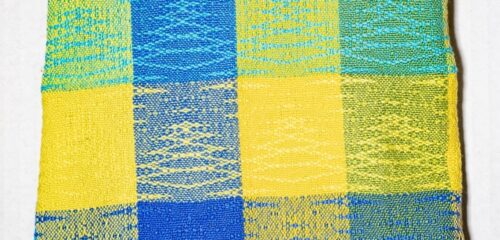
There are 456 ends in this towel. It measures 19″ wide in the reed.
The pattern changes do not line up with the colors. In the draft I used a solid purple to represent the multi-colored areas.

72 green
24 cream
72 ends in a variety of colors
24 cream
72 ends in a variety of colors
24 cream
72 ends in a variety of colors
24 cream
72 green

MAFA2023-004

I used Parson’s crepe threading, treadling and tie-up as referenced above, but added a band of my own design to one side of the towel.

MAFA2021-038

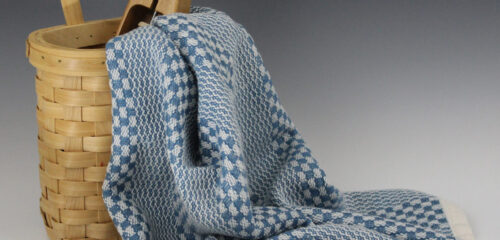
The original draft I found on the Schacht website had 414 ends, so I adjusted to 430 ends to meet the necessary width requirement. I also used a simplified threading, a draft of which was supplied to me by Judie Eatough.

I machine washed the towel in cold water and dried in the dryer on high heat to wet set. The towel was then pressed using a cotton and steam setting on my iron.

I used a 12 yard warp of 8/2 ring spun cotton and used Brassard’s 8/2 cotton for weft in the color Vieu Blue.

The towel was machine hemmed.

I love weaving these towels as the pattern is so easy to memorize and you can just weave almost without thought. The easy simplified threading I used makes threading the heddles an easy task.

MAFA2021-003

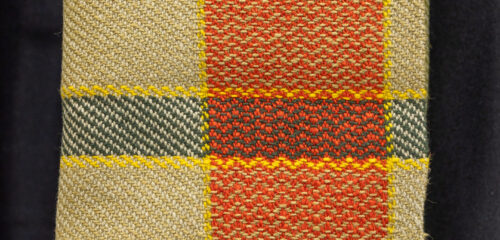
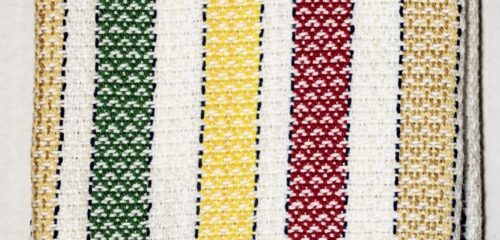
This towel is a design to combine waffle and tabby. I used five shafts for the waffle areas and three shafts for the tabby areas. For the waffle areas I sett the ends at 32 epi, tighter than the tabby areas of 24 epi. I also added several different colors for the waffle stripes while the majority of the warp is a dark neutral color.

Warp: 22/2 cottolin. Colors: tobacco 2017, maize, gold 2054, orange 2015, aqua 2032, pine 2065

Weft: Hem: 16/2 cotton, orange 62. Body: 22/2 cottolin. Colors: ochre 2011, maize, gold 2054, orange 2015, aqua 2032, pine 2065

Dimensions
Before washing: 21 7/8 inches wide and 36 1/4 inches long
After washing: 20 inches wide and 32 1/4 inches long

Warm water; regular cycle; iron while damp; no dryer

MAFA2019-061

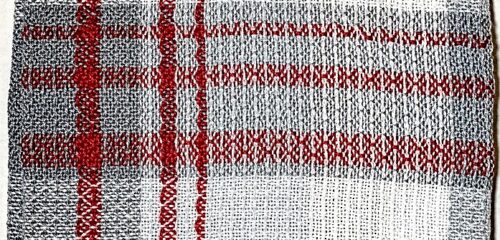
I wanted to use the ‘Netting A’ from Davison’s book page 95, but didn’t want to have to move heddles, so I used shafts 7 and 8 to substitute for shafts 2 and 3 when necessary. I also wanted a small selvedge and used shafts 5 and 6 for those. I tried three treadlings, but found the point twill treadling gave the best all-over texture I wanted. I had purchased the multiple shades of gray at the last MAFA Conference and used them for another project. I still had enough to weave this towel. I did have to fudge on the weft as I alternated white with what grays I had left. I used the Fibonacci sequence to design the red stripes for an accent and used a heavier thread for added texture. I am satisfied with the ‘modern’ appearance of the towel and may do more, though I think I’ll use a smaller accent thread as I’m not sure the 8/2 worked as well as I had hoped.